
Monday Message 08.12.25
LET US NOT FORGET…. JUSTICE
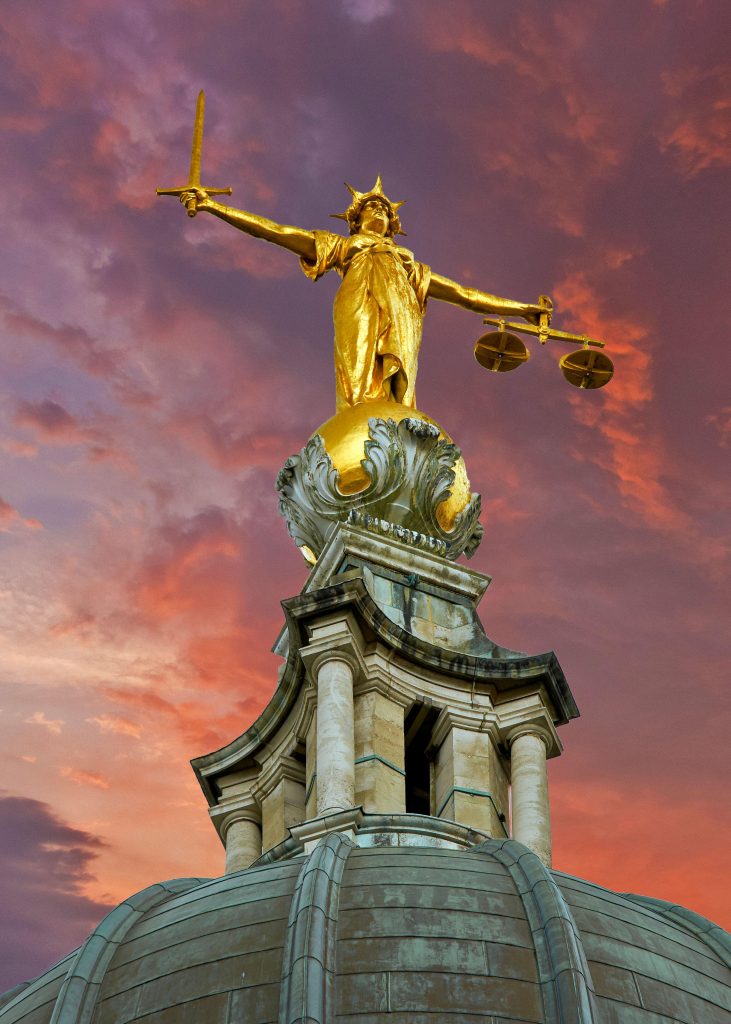
Our Lady Justice stands a-top one of our most venerated courts. She holds aloft a set of scales – finely balanced, to weigh the evidence, neither side over-weighed against the other.
She represents the essential qualities of Justice: Morality. Integrity. Impartiality. Independence. And FAIRNESS, the principle of deliberating without fear or favour, without pressure or partiality, without influence of external forces.
“The worst form of injustice is pretend justice” – PLATO (428–423 BC to 348/347 BC)
“If we do not maintain Justice, Justice will not maintain us” – Francis Bacon (1561-1626)
“In matters of truth and justice, there is no difference between large and small problems, for issues concerning the treatment of people are all the same” – Albert Einstein (1955)
“Ignorance allied with power is the most ferocious enemy justice can have” – James Baldwin (1972)
We circulated a short response earlier this week. Whilst there are things to be welcomed in the Deputy Prime Minister’s announcement, such as his commitment to the Criminal Bar, and the promise to increase sitting days, the CBA have made clear that:
The criminal barristers who prosecute and defend across England and Wales overwhelmingly oppose Judge-alone trials in the Crown Court.
We all accept that David Lammy MP has a difficult job, and in difficult circumstances. All are aware that the Criminal Justice System is in crisis – we have been telling successive governments so for years.
We all know and agree that extreme measures and deep pockets are required. But what this Government, through Mr. Lammy, is now proposing is simply not the answer. And it will not work.
Justice delayed may be justice denied, but justice that is delivered with the scales pre-weighted on any side is no justice at all.
Juries work – they do their job superbly, and without bias. Juries deliver Justice. They have not caused the backlog.
What we are doing:
- Speaking with One Voice
We have also jointly written to the Lord Chancellor and Secretary of State for Justice and Deputy Prime Minister, David Lammy MP
We are stronger together.
In the last 10 days I have had more than 25 meetings, and that excludes the daily calls with the Bar Council, Circuit Leaders, officers of the CBA, and other interested parties who are helping our cause. The other officers of the CBA are working equally hard.
This, together with our marshalling and engaging of press interest, has been the first step. But it is essential to recognise that there is a very long way to go in this war to retain the public’s fundamental right to sit on a jury, to be tried by a jury, and to have some input and influence on the Criminal Justice System. The timing of what we do is fundamentally important. We cannot pull out all the stops at once.
What we need you to do
The current battle is to be fought in Westminster, and here we need your support and your skills as advocates. A coalition is building of MPs and Peers from all parties, including Labour backbenchers, and many non-aligned voices who are against these proposals both on grounds of principle and because there is no evidence that this will be a solution to the Courts’ backlog.
We need you to sharpen your pens and hone your voices as advocates. And we need your collective voices to be heard by your local MPs, representatives in the House of Lords, and the general public, so that they stop and think about the issue, so that they don’t simply accept what they are told by the Government without question, so that they cease to believe that what is being proposed must be the only answer. We know it is not – but we need to convince those who have the power to stop this in its tracks to support us.
We have already asked you to write to your MPs. We know many have done so. We now ask you to write again, this time using a template that we have been working on with the Bar Council and Circuit Leaders. This will draw on the support of all the Bar, across specialisms.
The link, and details of how to do so can be found on the Bar Council website here: Leveson’s Independent Review of Criminal Courts
We will in the next month be asking you to escalate these efforts and amongst other things, will invite you to send out a further package of information, to ensure that the issues are not forgotten by the time this matter reaches a vote in the House.
Till then, that must be our focus. And – we do think that there is momentum to stop this. However, if the Government is successful, we look to next steps after that.
The Problems with the Lammy Proposals
We are deeply concerned about several aspects of David Lammy’s proposals. Even with the last-minute pivot from 3 years to 5 years and back down to 3, the proposals go far beyond what Sir Brian Leveson recommended. There was no courtesy of a formal published response to Sir Brian before their delivery. The Lammy recommendations plainly have not been well thought through and leave many questions unanswered – indeed it doesn’t appear that the Government can answer them. The plans are in our view unconscionable.
First – The clear bias in language used in delivery, particularly against those who are accused
Some of you may have heard David Lammy’s interview on Radio 4 last Tuesday before the announcement was made. The rhetoric was concerning.
In it, he said words to the effect of “if you have stolen a bike, or are in possession of a Class B drug, or own a dangerous dog, why should you have the right to a trial by jury?”….
Then in his speech to Parliament later in the day, he said that the proposed measures would “prevent defendants from gaming the system”. This appears to be based on an anecdotal account from a single Crown Court judge – it does not reflect the experience of most of the Criminal Bar who deal with those accused of crime daily. Rather, we frequently see terrified people, accused of crimes that they may not have committed.
The press statement which was issued to accompany the announcement proclaimed that the proposals are about “Justice for Victims”. That presupposes that we know before a fair trial has taken place who is the victim, and who is the guilty. Who is right, and who is wrong. Justice holds her scales in balance because she delivers justice for all in society. If decisions are taken on that assumption, and verdicts delivered on that basis, can that be Justice?
Such terminology, taken together with references to “victims” of crime, rather than “complainants” demonstrates an abandonment of the presumption of innocence, and, possibly, a cynical attempt to appeal to those who are less well informed.
Second – the unmistakable undercurrent of a concerning purpose beyond fixing the backlog
As Joanna Hardy-Susskind, of Red Lion Chambers, succinctly put it in her interview on BBC News Politics, “we are not seeking to convict as many people as quickly as possible – that is not justice. We are seeking to give people, whether the complainant victim, or the accused, a fair hearing”.
Third – misinformation and confusion in statements about the Magistrates’ Courts
Again, on Radio 4, on the 2nd of December, David Lammy said “there is no backlog in the magistrates’ court”. And in Parliament on the same day he said “the magistrates’ courts do not currently have a backlog, and with an increase in the numbers of magistrates, they can do a little more”.
Mr. Lammy’s own department at the end of September highlighted that the magistrates’ “receipts remained above disposals, which resulted in an increase in the open caseload to a series peak of 361,027” cases in the backlog.
And this is the system into which the Government proposes to shift a huge percentage of criminal cases.
It must be remembered that magistrates are not full-time judges. They are members of the public, un-paid volunteers, who fulfil this judicial function on a part-time basis, sitting approximately 13 days a year, essentially for free (they are allowed to claim a small amount towards lost earnings). There is a distinct financial incentive for the Government in shunting work to this cheap workforce.
Further, there does not appear to have been any thought given to the time those hard-working members of the public have available to hear cases. If more serious matters (attracting 18 month sentences, with a possibility of increase up to 2 years), these will be more complex, will involve far more serious offending, multiple defendants and witnesses, and could last weeks. How are magistrates to hear these cases? If a case goes part heard, we have all experienced how long it can take to work around the diaries of a panel of 3 magistrates, such that they can be reassembled.
There is no recognition of the fact that approximately 41% of appeals against conviction in the magistrates’ court are successful – which seems to indicate that proceedings in the magistrates’ court are, at least of those 41% occasions, flawed.
The removal of the automatic right to appeal in these circumstances, is extremely concerning, particularly when combined with the escalation in seriousness of offences magistrates’ may hear and the increase in their sentencing powers.
It will also add to the burden both on magistrates and Crown Court judges to respectively produce and then review detailed reasoned decisions in order to decide whether the verdict should be quashed. It appears to have escaped the Government’s notice that in a high proportion of cases this would result in two hearings (appeal and separate re-trial) when the current system involves only a single hearing.
And in respect of that escalation in sentencing powers, it was only last year that the Government increased magistrates’ sentencing powers from 6 to 12 months. And the consequence of that increase was a significant rise in prison sentences being imposed. Yet there has been no consideration of the impact of this decision on the prison estate, which currently has fewer than 2000 spaces left available to it.
We saw a similar pattern in June 2022 to March 2023, when the powers were increased, only to be decreased because too many people were being sent to prison for too long – the magistrates were simply getting it wrong.
How will this affect the public’s perception of Justice?
Fourth – the Crown Court Bench Division, and the variation on Sir Brian’s original proposal of judge and two magistrates for balance
The Government has decided to do away with Sir Brian’s suggestion of 2 magistrates to sit in the Crown Court Bench division. No doubt because there are simply not enough magistrates to do all this work.
But this ignores David Lammy’s own comments about diversity, which confirm what we all know – namely that the jury is the only part of the criminal justice system that it consistently without bias. We are all, each one of us, biased in some way. But when 12 are put in a room, they must discuss, debate, reason, and justify opinions. Bias will inevitably come to the surface, and will be exposed, but then neutralised by the other opinions present as they come together in support of a final conclusion.
Judges are all different human beings with different backgrounds, views, and biases. A judge sitting alone on a case will never have their bias exposed or challenged. Unlike a jury, judges in a CCBD will not sit once on a trial and then move on with their lives. They will hear the same types of cases day in and day out. How can they possibly avoid becoming case hardened?
Fifth – the lack of evidence and detail provided in David Lammy’s proposal
The Government have had 6 months or more to consider the Leveson proposals. In the week prior to the announcement, they chopped and changed, suddenly up from 3 to 5 years and then within days back down to 3. This leaves themselves open to the question – how well have they really thought these measures through? They are also pre-empting the Law Commission’s report on criminal appeals.
There seems to have been no modelling – certainly, we have seen none. We have asked, and none has been forthcoming. There appears to have been no costing, and there definitely has been no piloting. There is no certainty they will work, and poorly drawn comparisons with other jurisdictions that operate different systems are simply not good enough.
As HH Peter Collier KC, the former Recorder of Leeds, said this week, the Government’s estimates are “just fingers in the wind”.
The lack of clarity as to how the measures will ameliorate the backlog is concerning. If agreed by Parliament, they will take a significant amount of investment and time before the fruits, if any, are seen.
There is no evidence that demonstrates that trial by judge alone would be quicker than trial by jury. Rather, Mr. Lammy simply says: “In his report, Sir Brian estimated that the system would be 20% faster”. That is it. That is the basis for this bald claim that is being used to dismantle a system of Justice that has prevailed and been respected for hundreds of years.
And let there be no doubt, we are told that this is only a 20% reduction to the length of only 3% of all trials. And for that, the Government is prepared to ignite the touchpaper beneath our system of criminal justice.
There is no evidence to say that the measures proposed would have any impact at all on the backlog.
There is no detail as to which offences will be shifted to the Crown Court Bench Division. Are these cases with a maximum sentence of 3 years? Or cases with a higher maximum sentence that might, on their specific facts fall into a lower sentencing bracket as defined by the Sentencing Guidelines?
If the latter, which seems likely, what is the procedure by which a judge decides what the bracket is? Is there provision for some sort of Goodyear procedure? When will that take place? Is the judge’s ruling appealable?
In his interview on Radio 4, David Lammy was quizzed about what stage the absence of a defendant’s right to elect would come into play, whether this would be at the mode of trial stage, or later. He was unable to answer.
Sixth – How does any of what has been proposed affect the 80,000 (and 361,027) cases in the backlogs?
We appreciate the Government’s focus on victim complainants, but how does this additional delay help those who have been told their trials can not take place till 2029? Or the accused waiting to be able to continue their lives?
There is no detail as to whether the measures proposed would be retrospective. If not, they will have absolutely no effect on the backlog.
If it is thought they may be retrospective, there is no detail as to how they will be made so, nor any consideration of the many human rights issues and arguments that might arise should the Government attempt to make it apply to cases in the backlog where election has already been made.
Seventh – the lack of immediate investment into the Courts infrastructure
There was a list of some of the issues the criminal bar experience in Crown Courts across the country every day in the last Monday Message. Although there has been some investment in the court infrastructure this year, it is minimal compared to what is needed, and little immediate change has been observed.
Where are these CCBD cases going to be heard?
Where in our crumbling Court Estate will they be slotted in?
WHAT WOULD HELP NOW
There are things that we can do TODAY that will help to bring down the backlog. Why is the Government not focussing on these, seeing if they work before they take a wrecking ball to the Criminal Justice System?
What would help victim complainants and those accused of crime NOW are measures that would see the backlog reduce. We find it extraordinary that the Government has chosen to focus on the question of reform before Sir Brian Leveson has even had the chance to publish his Part 2 report into efficiency measures. We are confident that Sir Brian will in his Part 2 report, take account of all the submissions that the CBA, Bar Council and Circuit Leaders have put forward, together and separately, and will agree with much of what we have said. We expect Sir Brian to make a number of sensible and effective recommendations of things that will actively bring down the backlog. Not to consider these first, and before leaping into the abyss of total reform, is counter intuitive and contrary to proper Justice.
We know that there are areas of the country where efficiency measures have gone a long way towards eradicated the backlog – for example Liverpool and Wales have had great success – why should they have these reforms thrust upon them when their systems are working well?
We have made clear suggestions to the Government which need action now:
- remove the artificial cap on the number of sitting days;
- trust our Resident Judges to manage their own Courts properly;
- increase credit for guilty pleas;
- ensure that regular hearings are held nationwide to triage every case in the backlog;
- encourage the CPS and Police to make robust, brave and pragmatic prosecutorial decisions on cases in the backlog;
- overhaul and simplify the system of disclosure, including third party disclosure;
- ensure that proper, firm advice is being given to defendants who have no hope of acquittal;
- make more robust use of Goodyear indications;
- consider whether more out of court disposals may be appropriate in lower level offence cases;
- apply the recommendations of the Gauke review in respect of adjusting focus of sentencing to rehabilitation, using non-custodial sentences in appropriate cases, and early release incentives – and launch a campaign to adjust public expectations as to what a good outcome may look like.
- learn from centres such as Liverpool and areas such as Wales – where clearly efficiency measures work;
- work better with judges, list officers, CPS, defence teams;
- get prisoners to Court on time;
- deal with delays caused by lack of interpreters;
- improve the technology that we increasingly use to make it reliable;
- improve the Court Infrastructure so that days are not lost due to leaks, power outages, lift failures, water issues, heating issues etc.
- apply the recommendations of the Gauke review in respect of adjusting focus of sentencing to rehabilitation, using non-custodial sentences in appropriate cases, and early release incentives – and launch a campaign to adjust public expectations as to what a good outcome may look like. Punishment does not necessarily have to mean prison.
- Invest!
Conclusion
Our Lady Justice is often depicted blindfolded, though the statue on the dome of the Old Bailey is not – rather she looks out proudly, surveying the land with the pride and purpose that over 80% of criminal barristers still feel their work brings them.
If Our Lady Justice knew of the Lammy proposals, she might well beg for a blindfold to prevent her witnessing the complete catastrophe that will inevitably occur if they are followed.
To cure the Criminal Justice System of the injuries that years and years of neglect have inflicted, this Government must now invest in Justice and recognise that the healing process can not happen overnight. It will of necessity be a slow process which will have many stages.
It is perhaps telling that one can now buy a cheap, resin version of Our Lady Justice on Amazon for as little as £6.79. But that diminutive statuette has no beauty, no majesty, and commands no respect. That statuette is doomed to sit in a corner, gathering dust until it is thrown in a box to be sent off to a car boot sale.
Let not that happen to Criminal Justice in England and Wales.
and finally.
We would like to extend our heartfelt thanks to everyone who participated in the Winter Conference on Saturday, 6th December. The event was a resounding success, and we are especially grateful to all the speakers. A special mention goes to HH Geoffrey Rivlin KC for his insightful talk on the significance of juries, the Leveson inquiry, and the Government’s proposals. His presentation was met with a standing ovation!
Riel Karmy-Jones KC